
Tribal Child Support Start Ups
In 1996, the federal government created funding for Native American tribes to manage their own child support programs. Through this action, the government aimed to better meet the needs of Native American communities through recognizing tribal sovereignty. The funding initially operated in a cost-sharing model between the federal government and tribal governments.
In 2024, the federal government created a 100% funding mechanism for tribal child support programs. This removed financial barriers for Tribal Nations around the U.S. to provide holistic child support services to their families.
Child support programs have widespread benefits for tribal communities. These benefits range from improving parent-children relationships to lessening strain on other benefit programs. For example, child support offices can run employment services programs. These programs provide job training, financial planning services, and employment referrals.
Tribal child support programs are unique as cultures and values are carefully incorporated into programs. This is done in a variety of ways, such as non-cash child support payments or connecting with local support services within and near the Tribe.
Start-up Process
Starting a tribal child support program begins with research and fact-finding. It is important to understand what aspects of child support services are already in place in your jurisdiction, who are the potential partners providing these services, and what must be developed to fill the gaps.
Using this information, you can develop an application packet. This may sound daunting, but the process is collaborative! Regional OCSE representatives are there for support, and so are the directors of the sixty-three up-and-running agencies.
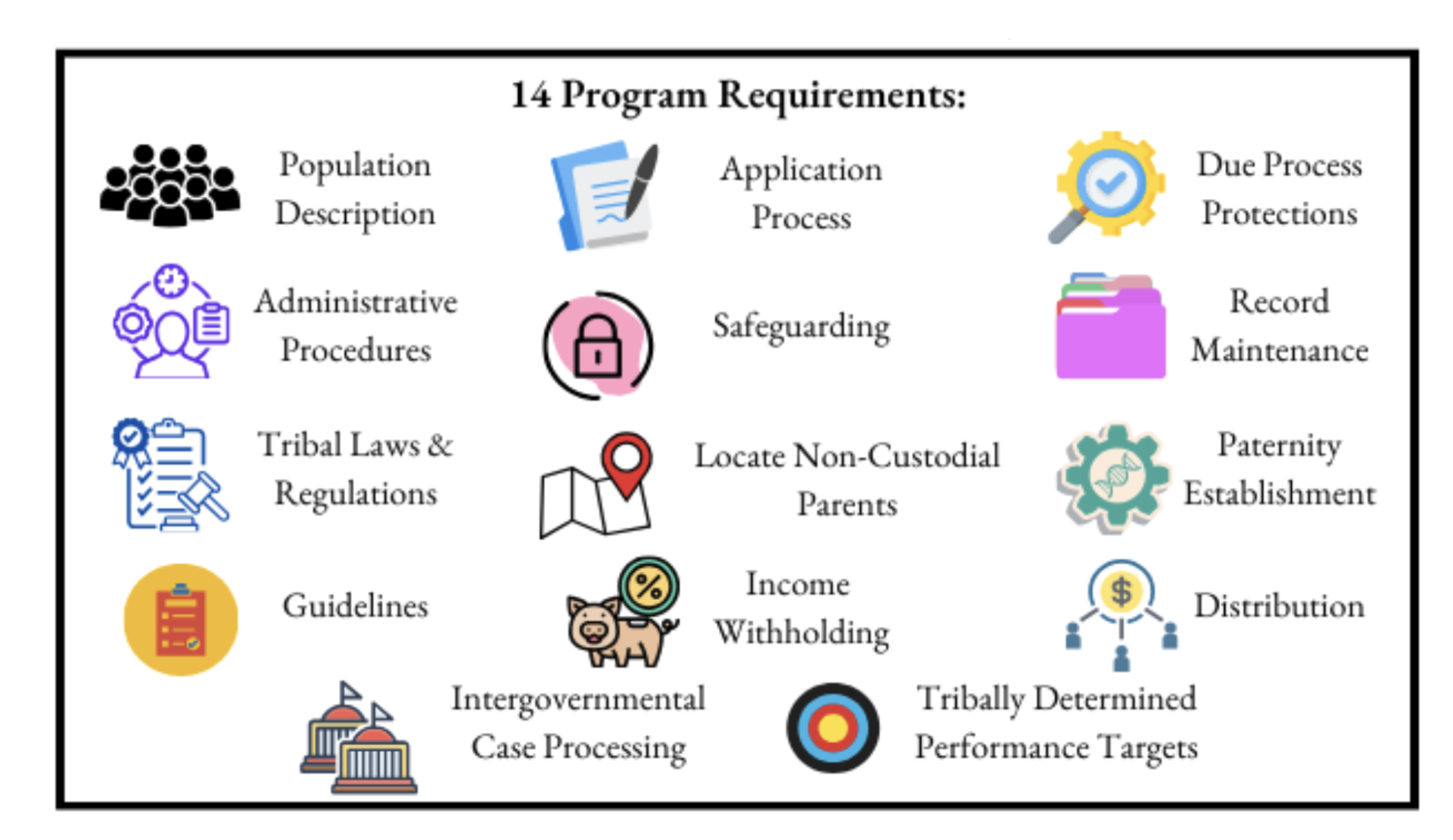
There are fourteen program requirements to meet during the start-up process, as shown below, in support of the development of a program.
Building Capacity
Receiving start-up funding is only the beginning. The two-year start-up period allows tribes to grow their proposals into strong child support programs. During this time, tribes hire and train staff, develop policies and procedures, and adopt Tribal code. The tribe must also build administrative systems in order to manage cases and meet federal requirements. These requirements include progress reports and budget proposals, while working within the $500,000 start-up budget.
This work is far more than completing a checklist. A new program needs dedicated staff who understand how to run it, policies which explain its operation, and sound administrative structure. Most importantly, that knowledge must remain with the tribe, even as employees and leadership change. By the end of the start-up period, a tribe should have the foundation of a program that meets federal requirements as well as the needs of its citizens.
Tribal-run child support programs can provide services beyond child support itself. There are a wide range of reasons parents cannot provide support. Tribal governments are in a unique position to decide how those issues, like employment or mental health, should connect to their child support programs and other services.
Tribes can build their capacity by bringing in outside assistance. Grays Peak Strategies works with tribal governments on program development and implementation. Our experience includes grant writing, project management, employee training, community engagement, and analysis of child support programs and processes.
Our work in Tribal Child Support includes supporting:
The Blackfeet Nation’s Iiksook’ksooksik project, which focused on financial literacy for young Blackfeet.
Multiple projects with the Lac Courte Oreilles Band of Lake Superior Chippewa Indians, addressing domestic violence safety, economic mobility, responsible parenting, and child support program processes.
The Muscogee (Creek) Nation on a waiver designed to increase reliable child support and financial self-sufficiency through education, employment, personal development, and cultural connectedness.
Four tribes as a part of the NextGen Employment Services, refining child support-led employment services with the Cherokee Nation, Nooksack Indian Tribe, Ponca Tribe of Oklahoma, and Lac Courte Oreilles Band of Lake Superior Chippewa Indians.
The development of start-up application packets and grant / waiver applications for tribal partners across Indian Country.
Designing and implementing a Tribal child support program is an opportunity to achieve the needs and values of a tribe’s community. As more tribes take on this role, child support can support children, families, and communities and create another pathway through which tribal sovereignty is exercised.